Prevention
Florida AC Maintenance Checklist: Monthly, Seasonal and Yearly Tasks
Most Florida AC failures give warning signs weeks ahead. This month-by-month checklist shows what a homeowner can handle, what needs a technician, and why each task matters in Gulf Coast heat.

Quick answer
A Florida AC maintenance checklist has three layers: monthly filter checks, drain-line vinegar flushes and outdoor-unit clearing; seasonal coil rinses after love bug swarms plus a spring hurricane check and fall heating test; and a yearly professional tune-up covering capacitor, contactor, charge and drain. Homes near the Gulf benefit from a second technician visit.
A northern air conditioner might run 800 hours a year. Here on the Gulf Coast, a system can log several times that, because Sarasota-Bradenton summers average highs near 91°F with overnight lows that barely dip below 75°F. A schedule written for Ohio falls short here. This checklist is built around our long cooling seasons, heavy condensate, love bugs, salt air and hurricanes, and it labels which tasks are yours and which belong to a technician.
The Checklist at a Glance
| Task | How often | Who | Why it matters here |
|---|---|---|---|
| Check and replace the air filter | Monthly in summer; every 1–3 months otherwise | Homeowner | A loaded filter starves the coil of airflow and can freeze it solid |
| Pour distilled white vinegar into the condensate cleanout | Monthly, June–October | Homeowner | Slows the algae slime that plugs the P-trap |
| Look into the secondary drain pan and test the float switch | Monthly | Homeowner | Standing water means the primary drain is failing |
| Clear 2 feet around the outdoor unit | Monthly | Homeowner | Mulch, palm fronds and hedges choke condenser airflow |
| Gently rinse the condenser coil with a garden hose | May and September | Homeowner | Love bugs and pollen mat the fins |
| Test heat strips or heat pump heating mode | Late October / November | Homeowner | Catches a failed heater before the first cold front |
| Pre-season hurricane check: pad, tie-downs, surge protector | May | Homeowner + technician | Loose anchors and failed surge devices show up only after a storm |
| Professional tune-up with electrical and refrigerant checks | Once a year (twice near the water) | Technician | Finds weak capacitors, pitted contactors and slow leaks early |
Monthly Tasks You Can Do Yourself
Filter: the cheapest insurance you can buy
Hold the filter up to a light; if light barely passes through, change it. One-inch pleated filters usually need monthly changes in summer. Be wary of the most restrictive one-inch “allergen” grades, which can choke airflow on many residential blowers. Low airflow is the top cause of the frozen evaporator coils we see in August.
Drain line and float switch
Pour about a cup of distilled white vinegar into the capped cleanout tee near your air handler, wait half an hour, then follow with clean water. Shine a light into the secondary pan under the unit; standing water there means the primary line is partly blocked. Our guide to preventing a clogged AC drain line walks through the float switch and outdoor outlet in detail.
Outdoor unit walk-around
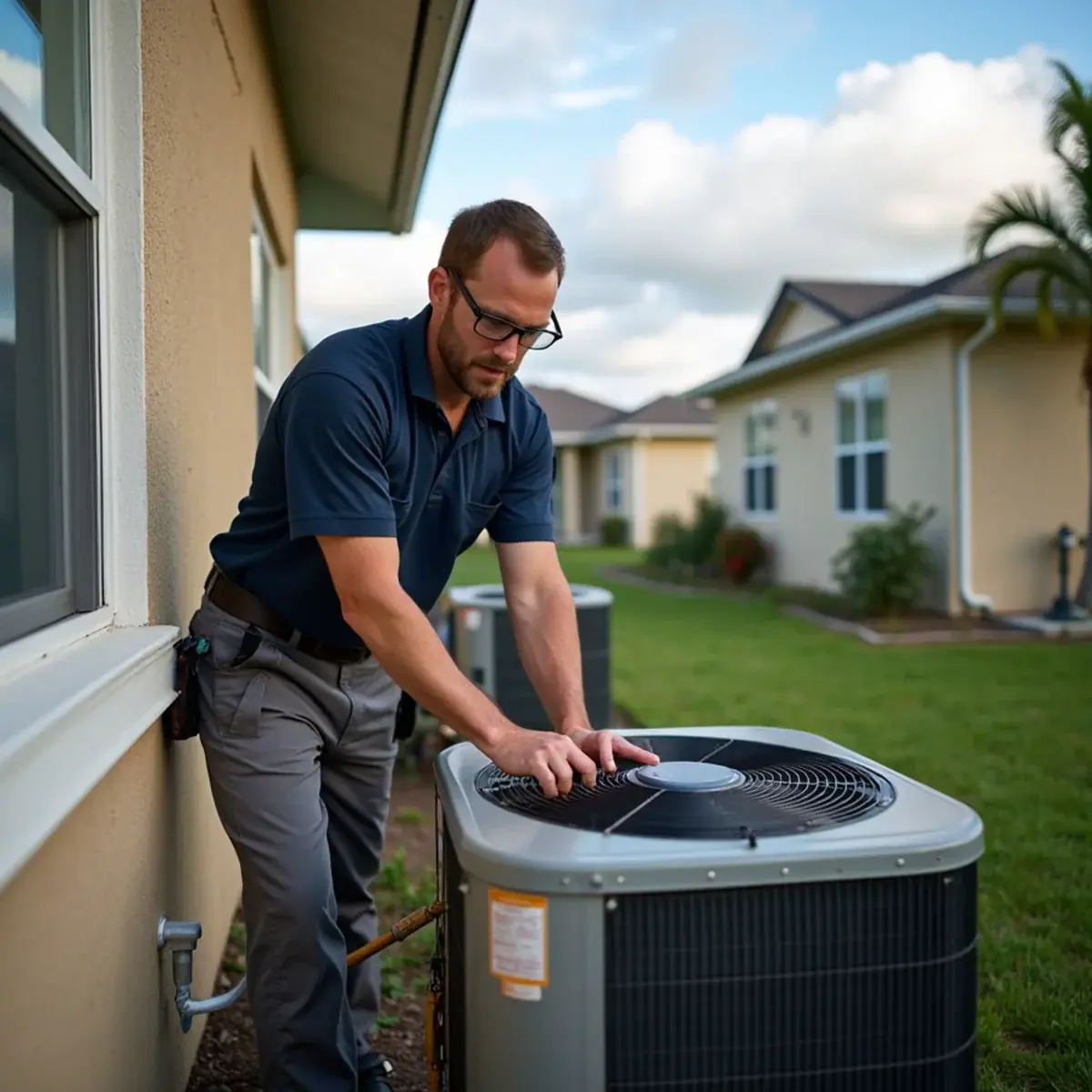
- Keep shrubs, fencing and stored items at least 2 feet from every side and 5 feet above the top discharge.
- Ask your lawn crew to blow clippings away from the condenser, not into it, and to keep string trimmers off the refrigerant lines.
- Listen at startup. A buzz that lasts a few seconds before the fan catches can mean a weakening capacitor.
Inside the house: registers, returns and the thermostat
The indoor side of the checklist takes five minutes a month and gets skipped more than anything else. Walk the house and make sure no supply register sits under a rug, a sofa or a closed bedroom door for weeks at a time. Vacuum the return grille, because a furry return is a sign the filter behind it is overdue. Glance at the thermostat, too:
- Keep supply registers open, even in guest rooms. Shutting several of them raises duct pressure, cuts airflow across the coil and can leave the closed-off rooms damp.
- Replace thermostat batteries once a year if your model uses them; a weak battery can blank the screen or cause erratic cycling.
- Keep lamps, TVs and afternoon sun off the thermostat so it reads the room, not a hot spot.
- Note any register that sweats or drips. Condensation on a grille points to low airflow or humid attic air leaking into the duct.
Seasonal Tasks Tied to the Florida Calendar
Spring (March–May): get ahead of the heat
Book the professional visit before the first run of 90-degree days, when every technician in Sarasota County is busy. After the spring love bug swarms fade, kill power at the outdoor disconnect and rinse the condenser from the inside out with a gentle hose spray. Never use a pressure washer; it folds the aluminum fins flat.
Summer (June–September): watch the water
Rainy-season humidity means your system pulls more water from the air than at any other time, so this is when drains clog. Keep up the vinegar routine and notice whether the house feels clammy at your usual setpoint; indoor humidity above 60% points to a drainage, airflow or sizing problem. Hurricane season starts June 1, so confirm your condenser is strapped down and your surge protection works.
Fall (October–November): the heating test
Run the heat for 15 minutes on a mild afternoon. A brief burning-dust smell from heat strips is normal. Lukewarm air, a tripped breaker or a heat pump stuck in cooling needs a look before the first cold front. September’s love bug flight also calls for one more gentle coil rinse.
The Yearly Professional Visit: What Should Be Checked
A real AC maintenance visit is more than a coil rinse and a filter swap. Ask whoever services your system whether their visit covers these items:
- Capacitor tested against its rated µF value, not just eyeballed.
- Contactor contacts inspected for pitting and burning, which lightning surges accelerate.
- Refrigerant charge checked by superheat (piston) or subcooling (TXV), not simply “topped off.”
- Compressor and condenser fan motor amp draw measured against the nameplate.
- Evaporator coil and blower wheel inspected, drain trap flushed and float switch tested.
- Electrical connections tightened and the disconnect checked for corrosion or water entry.
- Temperature split measured and thermostat operation confirmed.
- Accessible attic duct connections checked for leaks.
Newer Heat Pumps Need Maintenance Too
In the newer gated neighborhoods off Laurel Road, many owners assume a two-year-old variable-speed heat pump can run untouched. Drain slime, dirty filters and lawn-crew debris affect new equipment too, and inverter systems hide problems well: they slow down and keep going, so a plugged coil shows up as a higher power bill before it shows up as warm air. Many manufacturer warranties expect registration and reasonable maintenance, so if you live in Laurel, keep a simple service log and confirm your registration was completed.
What We Find When the Checklist Gets Skipped
On Venice-area maintenance calls, the problems we find are rarely exotic. They are small checklist items that slid for a season or two and started costing capacity. These are the patterns we see most, and the measurements we use to catch them:
- Filters that fit badly. A filter one size too small, or slid in with the airflow arrow backwards, lets dust bypass straight onto the coil. We find more dirty coils behind loose filters than behind old ones.
- Capacitors drifting out of spec. A dual run capacitor often keeps the system running while reading below the tolerance printed on its label, commonly ±5% or ±6%. We test it with a meter against that rating and replace it before it strands you on a July afternoon.
- Vinegar in the wrong opening. Homeowners sometimes pour into a float-switch port or the secondary drain instead of the primary cleanout, so the trap that actually clogs never gets treated. We point out the right fitting and label it.
- Sun-rotted line insulation. The foam on the large copper suction line breaks down in Florida sun and under string trimmers. Bare pipe sweats, drips on the pad and picks up heat before the refrigerant reaches the compressor.
The trade-off we explain most often is filter grade. A high-MERV one-inch filter catches more, but on many residential blowers it also chokes airflow. If you want finer filtration, a four- or five-inch media cabinet does it with far less restriction. We also record the temperature drop across the indoor coil each visit, because a split that shrinks from one year to the next flags a dirty coil, low airflow or low charge long before the house feels warm.
Put the Checklist to Work
Some findings should not wait for the next scheduled visit: ice on the suction line, water on the ceiling, a burning smell, or an outdoor unit that hums while the fan sits still. Those call for AC repair, and a frozen system should be shut off at the thermostat to protect the compressor. For everything else, tape the table to the inside of your air handler closet door and write the date each time you change the filter or flush the drain. When it is time for the yearly technician visit, call (831) 461-3437 or send a quote request. Goran will tell you plainly what your system needs and what can wait.
FAQ
Common questions
How often should I change my AC filter in Florida?
For standard one-inch filters, check monthly and expect to replace them every 30 days from May through October, when the system runs almost constantly. In cooler months, every two to three months is usually enough. Pets, renovation dust and tracked-in sand shorten that. Thicker four- or five-inch media filters typically last several months.
Is once a year enough for professional AC maintenance?
For most inland Venice-area homes, a thorough annual visit in spring is enough when you keep up with filters and drain flushing yourself. Homes close to the Gulf or the bays, systems over 12 years old and heat pumps used heavily in winter benefit from a second visit in fall, since salt corrosion and heating components deserve their own check.
Is it OK to close AC vents in rooms we don’t use?
Closing one register rarely hurts, but closing several usually backfires. Central systems are designed to move a set amount of air, so shutting vents raises duct pressure, reduces airflow across the indoor coil and can make leaky ducts leak more. The closed rooms also stop being dehumidified and can turn musty. If a room is truly unused, leave the vent open and the door cracked.
What happens if I skip AC maintenance for a few years in Florida?
Usually nothing dramatic at first, which is why it gets skipped. Meanwhile the drain trap fills with slime, the capacitor drifts below its rating, the coil loads with dust and the refrigerant charge may slowly drop. Efficiency and moisture removal fade quietly, and the failure tends to arrive on the hottest week of the year, when parts and appointments are hardest to get.
What should I write down in an AC maintenance log?
Keep it simple: the date and filter size each time you change it, each vinegar flush, and any drips, noises or tripped breakers you notice. After a professional visit, add the technician’s readings if they share them, such as capacitor values and temperature split, plus any part replaced. That record helps with warranty questions, a future home sale and spotting a slow trend.
About the author
Written by the team at Brothers Services Cooling & Heating, an owner-operated HVAC contractor in Venice, FL. Goran and crew repair, replace and maintain air conditioners and heat pumps across Sarasota County every day — this article reflects what we see on real Gulf Coast service calls.