Core Service
SEER2 Explained: Choosing an Efficient AC for Southwest Florida
New ACs in Southwest Florida must meet at least 14.3 SEER2, but the right rating for your home depends on runtime, humidity and ductwork. Here's how to choose without overpaying.
Quick answer
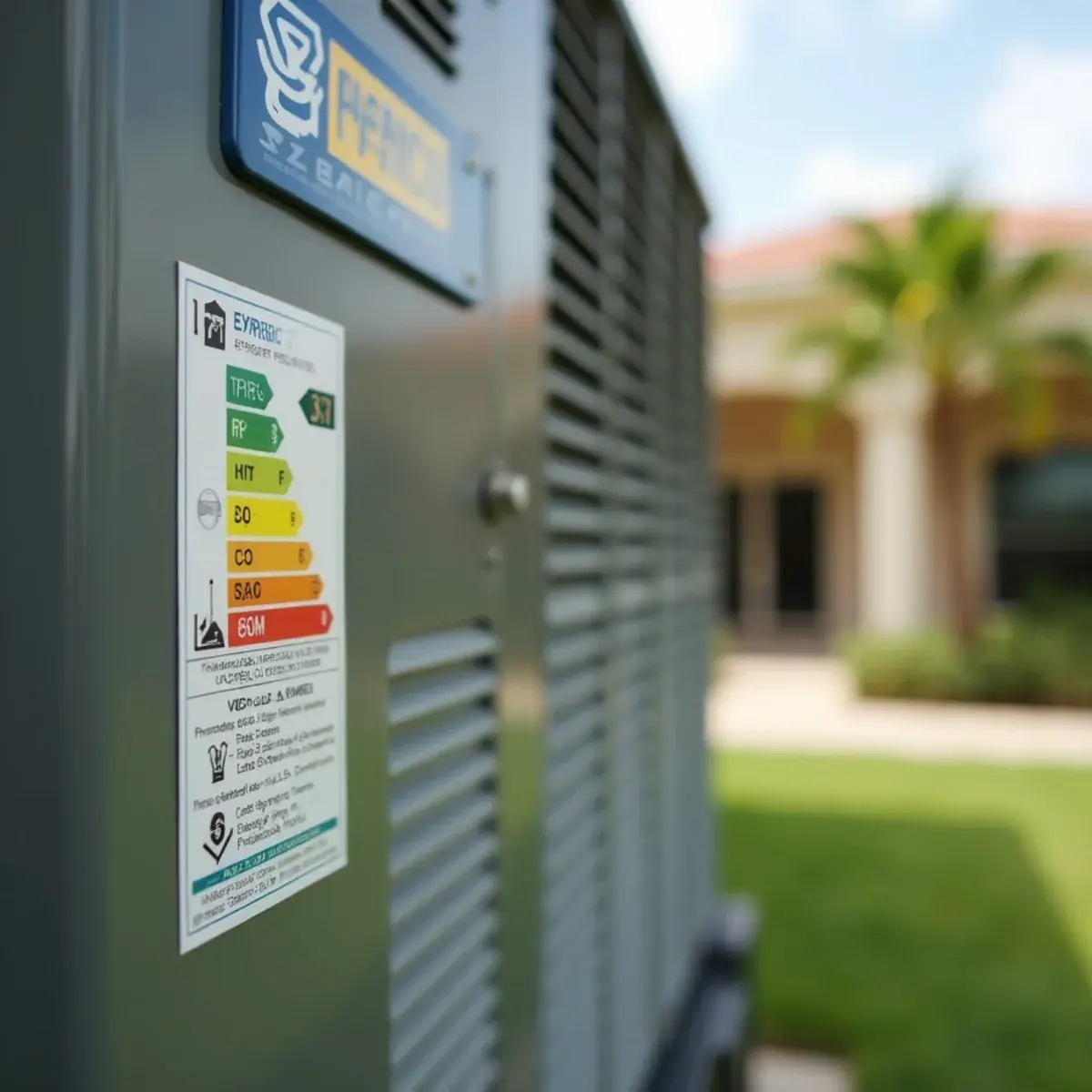
In Southwest Florida, a new home-size split AC must meet at least 14.3 SEER2, roughly equal to the old 15 SEER. For many full-time Venice-area households, a two-stage system in the 15–17 SEER2 range balances cost and humidity control; variable-speed 18–20+ SEER2 pays off mainly with long run hours and good ductwork.
SEER2 is the efficiency rating on every new air conditioner and heat pump sold since 2023, and in Southwest Florida the minimum for a typical home system is 14.3 SEER2. Whether it's worth paying for 16, 18 or 20+ depends less on the sticker than on how many hours your system runs, how much humidity you fight, and whether your ducts can deliver what the equipment promises. Here's what the number means and how to pick one.
What SEER2 measures, and why it replaced SEER
SEER2 stands for Seasonal Energy Efficiency Ratio 2: total cooling delivered over a typical season divided by the electricity used. Higher means less power for the same comfort. The “2” reflects the Department of Energy's updated M1 test procedure, which raised the external static pressure in the test from 0.1 to 0.5 inches of water column. That's closer to how real systems behave when pushing air through filters, coils and ductwork. The same equipment therefore rates a few percent lower on SEER2 than it did on the old SEER scale, so 14.3 SEER2 is roughly equivalent to 15 SEER.
You'll also see EER2, a steady-state rating at 95 °F outdoors. It isn't part of the Southeast minimum, but it's worth a glance in Florida because it reflects how a system performs on long August afternoons.
The Southeast minimums you'll see on quotes
| Equipment | Minimum rating | Rough old-scale equivalent |
|---|---|---|
| Split AC under 45,000 Btu/h (most homes) | 14.3 SEER2 | About 15 SEER |
| Split AC 45,000 Btu/h and larger | 13.8 SEER2 | About 14.5 SEER |
| Split heat pump (all sizes) | 14.3 SEER2 and 7.5 HSPF2 | About 15 SEER / 8.8 HSPF |
Ratings apply to a matched system: a specific outdoor unit paired with a specific indoor coil or air handler, certified by AHRI. Put a new condenser on a mismatched coil and the rating on the brochure no longer applies. Every legitimate quote should list both model numbers and an AHRI certificate number.
Packaged units and mini-splits follow different numbers
The table covers split systems, which is what most Venice-area houses have. Packaged units, where the compressor, coil and blower share one outdoor cabinet, have a national minimum of 13.4 SEER2, and packaged heat pumps also need 6.7 HSPF2. You'll find them on some manufactured homes, flat-roof additions and small commercial buildings. Ductless mini-splits carry SEER2 ratings too, but they're tested without the duct losses a central system has to overcome, so compare a mini-split's rating against other mini-splits rather than against a ducted system.
How much does a higher SEER2 save in Southwest Florida?
Compressor energy scales roughly inversely with the rating, which makes the comparison simple:
| Rating | Approx. cooling energy vs. 14.3 SEER2 | Typical equipment type |
|---|---|---|
| 14.3 SEER2 | Baseline | Single-stage |
| 16 SEER2 | About 11% less | Single- or two-stage |
| 17 SEER2 | About 16% less | Two-stage |
| 20 SEER2 | About 29% less | Variable-speed inverter |
| 22 SEER2 | About 35% less | High-end variable-speed |
Why it matters more here: Sarasota-Bradenton averages summer highs around 90.8 °F with lows near 74.7 °F, and racks up roughly 1,637 cooling degree days in summer plus about 1,076 in autumn. A full-time Venice household runs its AC most of the year, so a percentage saving applies to a big number. A snowbird home closed from May through October with the thermostat set high sees much less return on premium efficiency.
Run the payback math on your own electric bill
- Find your cooling share. Compare the kWh on a peak August bill with a mild month when neither heat nor AC runs much, often March or November. The difference is a rough monthly cooling figure.
- Apply the table. Multiply that monthly cooling kWh by the percentage for the rating you're considering, such as about 16% for 17 SEER2.
- Put a price on it. Multiply the saved kWh by the rate per kWh printed on your bill, then by the number of months you actually run the AC hard.
- Compare it with the quote gap. Divide the price difference between the two systems by that yearly saving to get years to payback, and weigh it against how long you expect to own the house.
The table compares new systems with each other. If you're replacing a tired unit from the 10 or 13 SEER era, both options save noticeably more than these percentages suggest, which narrows the gap between them.
Why staging and humidity matter more than the number
Florida comfort is half temperature and half moisture. A single-stage system runs at full blast, satisfies the thermostat quickly and shuts off, often before the coil has wrung much water out of the air. Two-stage and variable-speed systems spend most of their time at lower output, which keeps the coil colder for longer and removes more moisture. That's how you get a house that feels comfortable at 77 °F instead of clammy at 73 °F. The target is indoor humidity between about 40% and 60%, and under 60% to discourage mold. If you already fight musty closets, pair the equipment decision with a look at humidity control.
Where rated efficiency gets lost
- Leaky attic ducts running through 130 °F+ air, dumping cooled air where nobody lives.
- Undersized returns that drive static pressure above what the equipment was rated for.
- Dirty coils: love bugs in May and September, lawn clippings, oak debris and irrigation overspray.
- Incorrect refrigerant charge. Superheat and subcooling need to be set to the manufacturer's spec, not by feel.
- Salt-pitted condenser fins on waterfront homes, which choke heat transfer.
Regular AC maintenance protects the efficiency you paid for. A neglected 20 SEER2 system can easily perform like a tired 14.
Venice Gardens homes: efficiency starts with the ducts
Many Venice Gardens homes are 1960s–1970s CBS block houses with closet air handlers and original or patched duct runs. Returns in these homes are frequently undersized, and supply boots have often pulled loose over decades of attic heat. Drop a variable-speed 20 SEER2 system onto that ductwork and it will ramp its blower up against the restriction, burning some of the savings and sometimes getting noisy. The better sequence is a Manual J load calculation, a Manual D duct check, and then the equipment choice. Sometimes a mid-tier system plus duct repair beats a premium system on old ducts.
A practical way to choose
- Minimum (14.3 SEER2): reasonable for a rental, a seasonal home, or a house you plan to sell soon.
- Mid-range (15–17 SEER2, often two-stage): the sweet spot for many full-time residents, with a real step up in humidity control.
- Premium (18–20+ SEER2, variable-speed): makes the most sense for full-time residents with long run hours, humidity problems, or a tight, well-insulated house.
- Ask for the AHRI certificate so you know the quoted rating applies to the exact pair being installed.
- Check rebates. FPL has advertised an instant rebate for qualifying high-efficiency AC through participating contractors. Verify current terms with FPL.
Also keep in mind that new split systems installed from 2026 generally use R-454B or R-32 refrigerant, so the SEER2 figures you compare now are for that new generation of equipment. For pricing context, see what a new AC costs in Sarasota County in 2026.
Where the rating is won or lost on install day
A SEER2 number is earned in a lab at a set static pressure and a set airflow. Whether your system matches it depends on what happens during commissioning, and in Venice-area attics and closets that's where we see the gap open up. On a typical install we check:
- Total external static pressure, measured with a manometer across the air handler and compared with the blower table. If it's over spec, the blower works harder and delivers less air than the rating assumed.
- Blower airflow per ton. Many systems ship set near 400 CFM per ton. In a humid house, a lower setting or the manufacturer's dehumidify mode keeps the coil colder and pulls more water, at a small cost in rated efficiency. We explain that trade-off before choosing.
- Charge by the numbers. Superheat or subcooling set to the manufacturer's target after the line set is evacuated, never topped off by feel.
- The right thermostat. A common mistake we find is a variable-speed system wired to a basic single-stage thermostat, so it never uses its low stages and runs like cheaper equipment.
Get a recommendation you can check
We'd rather sell you the right 16 than the wrong 20. For honest AC installation and replacement advice from Brothers Services Cooling & Heating, call (831) 461-3437 or request a quote, and every option will come with its model numbers, rating and full price.
FAQ
Common questions
Is 14.3 SEER2 the same as 15 SEER?
Roughly, yes. SEER2 uses a tougher test with higher airflow resistance, so the same equipment scores a bit lower than it did under the old SEER method. A 14.3 SEER2 system is generally considered equivalent to about 15 SEER. When comparing an old unit's label to a new quote, keep that conversion in mind so the upgrade isn't understated.
Can I still install a 13 or 14 SEER air conditioner in Florida?
Not as new equipment. Since January 1, 2023, new split AC systems installed in the Southeast must meet the regional minimum of 14.3 SEER2 for most residential sizes. Your existing lower-efficiency system can still be repaired and kept running. The rule governs new installations, not systems already in your home.
Do high-SEER2 systems cost more to repair?
They can. Variable-speed systems use inverter boards, ECM blower motors and more sensors, and those parts cost more than a single-stage contactor and capacitor. In exchange you get better humidity control and lower bills. Near salt water, protecting the outdoor coil and electronics matters even more, so budget for routine maintenance.
What SEER2 rating is best for a Florida home?
There's no single best number. A seasonal home or rental is often well served at the 14.3 SEER2 minimum. Full-time residents usually get the best balance from a two-stage system in the 15–17 SEER2 range, and variable-speed equipment above 18 SEER2 makes sense when run hours are long, humidity is a fight and the ducts are sound. The right answer comes from your bill, your house and how long you'll stay.
About the author
Written by the team at Brothers Services Cooling & Heating, an owner-operated HVAC contractor in Venice, FL. Goran and crew repair, replace and maintain air conditioners and heat pumps across Sarasota County every day — this article reflects what we see on real Gulf Coast service calls.